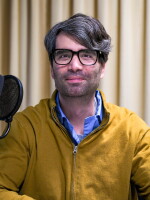
Mark Munger: Morningside University's Spanish Film Festival continues on October 20th with Drag Invasion. Festival coordinator and professor of Spanish Stacey Alex joined me for today's Manager's Special.
Stacey Alex: Yeah so this is about RuPaul's drag queens going on tour, and this is a documentary about their time in Peru. And so there is an assumption on part, I think, of the queens that you know they're going to a very conservative country. How are things going to go? Are they going to be rejected? And they saw their shows every single night, and they're received in this very warm and welcoming way. Their fans show up at the airport; they show up everywhere, right, to to talk to them, and it's just a really really beautiful documentary. And we're very lucky that we collaborated with SUX Pride to select this film, right? So I selfishly picked most of these because theythey go along with my curriculum, right? I have a whole unit about you know Aztec culture, right? For Aztec Batman, I have a whole unit about the Dominican Republic, right? So we're doing Boca Chica. But Drag Invasion really was collaboratively decided upon, and we have a really wonderful and thriving drag scene here in Sioux City. So, Brian Meland, who's the executive director of SUX Pride, helped us choose that film and is also going to introduce it both nights, and he'll be there to talk about why why drag is so powerful. And I think it's really an opportunity to help address some misconceptions about what drag is, and that there's just so much diversity in terms of what drag performance can look like. It can be very much clowning, right, but it can also be full glam. There's just this huge spectrum, but you know, most of it is about creating a sense of belonging, right, celebrating diverse identities, so I really hope people get excited for that one, and and that Brian Meland will be joining us.
Mark Munger: This film or this subject to your students is... what are the questions they're asking?
Stacey Alex: I think one of the reasons I've pursued this line of research, right, is that when when I started telling people about my interest in in drag performance, their first assumption was, oh well, that must be really hard because you know people from Latin America are so you know anti gay, so so, you know, not not accepting, right? And I I think that that we need to work through those assumptions, right? Because in fact, you know, I have several close friends who are Latina drag performers, right? And there, there is this really wonderful sense of belonging and community right here in Sioux City, right? But also across the country, right? So we can't make... I think what I want students to understand is that you know the intersectionality, right, of of all of the ways that we, you know, understand our identity, right, means that it's more complicated than we might think at first glance, right. Just because I know one thing about a person's identity does not mean I can assume all the other parts of their identity. So yeah, I and I have done a little bit of research about local drag performances, and I share that with students because I do want them to understand how diverse identities of gender and sexuality are within Latino communities.
Mark Munger: Yeah. Well, I think that there is a danger of using yourself as the lens and your own understanding of say religious belief or or conservative nature and how it might lead you to come to conclusions about a specific culture or sexuality. Well, that's fun. Drag invasion.
Stacey Alex: Oh, it's so much fun.
Mark Munger: October 20, UPS, and the 24th in the Klinger Neil. And then the final film of the festival is Home Is Somewhere Else, and that is November 5 and November 7.
Stacey Ale: Yeah, this is a beautiful documentary. It is a animated documentary. It is voiced by three young people talking about their experiences with mixed immigration status and their own families, and also in a couple instances their own experiences with deportation. And again, I you know it's you would think this is a really hard film to watch, but because it's animated, right? I think it gives you the sense that you know these these young people are given the agency to talk about what has happened to them and how they've moved forward without kind of the retraumatizing, right, of of using their their actual image, right. So the the artwork is just fantastic and there are a couple of different styles right the the style changes based on on the the voice that we're hearing, and one of them is a spoken word poet, kind of the MC of the documentary, and he's just amazing. So yeah, I really hope people turn out for this one. I just tell my students, you know, if you are thinking about working with young people anywhere in this country, you really need to to come see this, whether it be in social work or education or the health system, right? You cannot assume that you know if a person is dealing with this just based on the way they look, right? Because we're talking about millions, millions of folks that are going through this, but then they all are part of families, right? So then, you know, it's exponential, right, in terms of the number of people affected by this.
Mark Munger: And why did you choose to end with this documentary?
Stacey Alex: Well, you know,, I have noticed that students are are wanting to talk about this and what they see in the news, but they're not really sure how to even begin the conversation, right? And my research is about, where are the stories that are written by undocumented people themselves, right? There's so much theory about you know if a person is removed from a marginalized position, can they really tell that story anymore, right? And and I work with several different, you know, pieces of theater biographies where undocumented folks are telling their own story, which I think is so important, right? To hear it from from the source, right? I think media tries really hard, right, to tell that story and to represent marginalized voices, but often what we see is, you know there's a lot of attention on maybe just one person that can kind of miss the patterns, right, that can miss that oh oh this is actually you know it's happening to millions of people right now and I think that the documentary does a really good job of that
Mark Munger: So some media does a good job of it?
Stacey Alex: Yes, yeah yeah yeah.
Mark Munger: It is hard to tell a million stories at once in defense of of my my field.
Stacey Alex: Of course, of course. Well, it's just the nature of it, and the the example I always give students is you know Elian Gonzalez, right, was this Cuban boy, right, who was caught in a custody battle, right back way back when, right, and and you know it just it becomes or and because you know Liam right is the little boy in the bunny hat right that we've seen on TV, which becomes this powerful symbol, right? But sometimes when we just have that individual story, we don't get the multiplicity, right? And the fact that we have three voices here, I think, really helps flush that out, right? That we're not just talking about one person.
Mark Munger: Yeah, absolutely. No, I agree. The more voices we can hear, the better, and it's great that you've brought so many voices to the screen and to our community through this series. So, what a wonderful thing! I hope it can happen again in the coming year. I know that it's not an easy thing to get going, and you've had a lot of support.
Stacey Alex: I really do think we live in a community that really has a sense of cultural humility and wants to learn about other cultures. And, you know, I I think this is our forever home. We really love that about this community that that people are always looking for new ways to learn and expand their perspectives.
Mark Munger: Yeah, come on down. Come on down. Here's a chance. All right. Thank you, Stacy.
Stacey Alex: Thank you.
Mark Munger: Stacey Alex, professor of Spanish and coordinator of Morningside University's Spanish Film Festival, joined us for today's Manager's Special on Siouxland Public Media. Drag Invasion screens October 20th in the UPS Auditorium and on the 24th in the Klinger-Neal Theater. Home is Somewhere Else screens November 5th and 7th in the Klinger-Neal. down till you're on the ground.