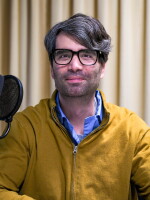
Mark Munger: Educator, author, activist, raconteur, and family-man Bruce Hopkins died peacefully in his home on September 18, 2026. His wife Jeanette, caring to the end, is also an educator, activist, and family-centric person. Over time, her marital role evolved from loving partner to caretaker for Bruce, who was diagnosed with Alzheimer's more than a decade ago. She was gracious enough to allow me into her home to talk. The walls, the tables, the shelves, everywhere, there were pictures of family, or pieces of art.
Jeanette Hopkins: This is one of Barry's early pieces, and Barry and Bruce were pretty bawdy together, too.
Mark Munger: So Barry was his brother.
Jeanette Hopkins: Barry was his brother. Yeah, younger brother.
Mark Munger: These are all...
Jeanette Hopkins: They're all pencil. Pencil.
Mark Munger: And they're the woods. These are the woods he grew up.
Jeanette Hopkins: Yeah, the Catskill Mountains. Glenford Woods is what Bruce called them. I don't know if they're known as the Glenford Woods, but he and his brothers were all runners, and it makes sense when you realize they went to country school, and they ran to school, ran home for lunch, ran back to school. He liked to equate himself to the Kenyan runners, who would go ten miles to school, ten miles home to grandma. And grandma and grandpa were certainly at the house, you know, with lunch.
But hunting, fishing, that was a way of life. It was a tough life, not unlike rural America. Where I grew up, it was equally as rural. I think that's why we got along so well, is that we understood rural poverty. We understood how tight rural people were, and we also understood, maybe, some of the rough things about being poor and huge families. And he writes about that in his first book.
And that's another thing with the kind of families that we had. Everybody should have cousins, because you have these huge picnics and gatherings.
And he would talk about in the mornings the grandparents. One was blind. One had dementia. They would be over for coffee every morning, you know. He'd go fishing with his grandfather, who couldn't see, was blind.
It was illegal to fish on the Ashokan Reservoir, but they'd go fishing there, and he would swear that his granddad, Bruce would say, his granddad had the only license to fish. Now I have a hard time believing that they gave his grandfather a license, but that's what he would say.
And we got married at the DeSoto Bend Wildlife Refuge in Missouri Valley. First and only couple to get married there.

Mark Munger: No!
Jeanette Hopkins: Yes, unless they were, you know, subversive, because the group, the manager at the time, said as long as you don't, you know, broadcast it, don't put it in the paper. But they got in trouble, and then they made a policy that you couldn't get married there. So I'm pretty proud of that.
This one was taken or written about a hemlock forest that was cut down, basically.
What happens when it's all gone?
And we're seeing that now. The impact.
Mark Munger: Would you be willing to read it?
Jeanette Hopkins: I can try. It's called Forest Sojourn.
So you walked through the forest. Did you notice that the flowers were not perfect, that the sky was pale towards gray, and that the wind had no direction?
So you walked through the forest. Did you smell the loam? Did you feel the small rocks interspersed with tracks of ants and twigs that rot in random fashion?
So you walked through the forest. Did you hear the sounds that the mice make in anticipation of a nocturnal commitment, the shadow of a hawk, and the venal structure of a rotted leaf.
So you walked through the forest. Did you feel the giving away of spider webs, introspective, shy, and unobtrusive, the bending of grass and the forlorn cry of the native one?
Bruce and his brother did an art show in the in the Appalachian Mountain area, up at a lodge, and his brother framed several of his poems, adding a little bit of, you know, birch, yeah, leaves. This one's all surrounded with leaves. Pretty cool.
Mark Munger: The forest seems to be very important to Bruce.
Jeanette Hopkins: Huge, and that forest versus like the Rocky Mountains is a very different forest. Bruce's forest turned incredible colors in the fall. Nothing like it. There's just nothing like it. The orange and the red.
One year we went out and I couldn't get over how beautiful the colors were, and his nephew said, "Oh, they're a little dull this year. It was really dry." And I don't know what dull meant to him, because they were amazing. Amazing. The colors were amazing.
I got few gifts from Bruce, very few. But even when he was really sick, and I'm still finding them, I get little notes. He'd write to me, even when he didn't know me, he knew me.
I was his caregiver, and I think I've alluded to this before. When you take care of somebody like that, like we had, I mean, we were living in our little microcosm of a world. You become, hopefully, compassionate, and that's a whole 'nother level of love. It just is. It's, I think, what we're supposed to reach in our lifetime, and both of us, I think, we felt that. He did.
Mark Munger: You say he gave this to you?
Jeanette Hopkins: All over. He'd leave me notes. I'm finding them in books. But we used to write to each other at work, so we'd get these letters. I mean, I'm still finding them. He's got journals. I'll show you in a second. Probably sixty or seventy journals. Some are in boxes out in storage.
And up until probably the second year of COVID, he was still writing. He was still reading, and then when he stopped, he stopped. He he couldn't get the words down. He couldn't get... he couldn't read, and even not knowing, he knew. That frustrated him. That was something he really missed.

For a while, he just copied things. That was heartbreaking to me that he was copying things instead of writing. He thought little of copying, you know.
He also thought little of revision! And if you get to talk to my sister, I was his editor first, and he wouldn't revise. And at one point, I said, "We're going to get a divorce if this continues!" I was so angry.
I think people have it wrong with Alzheimer's.
I think there is a part of your brain that gets tapped into that hasn't been tapped into. There are so many brain cells we don't use, so some are dying and others are kind of brought to life. And it may, I don't know, it may seem like I'm just grasping at straws, but we had conversations the day he died, and I could follow them. Some were pretty goofy. Some were were very goofy. Like the the day he died, he had fallen, and I couldn't get him up. And he said, "Well, can't you go get your husband to pick me up?" And I said, "No."
I said, "You're my husband."
And he said, "Well, go get my wife then to pick me up."
I said, "No, I'm your wife."
He said, "Well, go get those big boys," and the big boys were the fire department guys who would come over and help me when I couldn't get him up.
So, you know, he appreciated and loved me as his caregiver, and I, I will never, ever, be resentful or ungrateful for that. It's like we got to fall in love again.
I think that's incredible. Everybody should experience that. It was probably a week or two before he passed, and it was at that moment I realized how much I loved him. This person with Alzheimer's, I loved this person, who wasn't the original Bruce. Because he was so gentle and so appreciative of me all the time.
He would say thank you. He would thank me and be grateful, and and I wasn't always, you know, gentle and kind.
You get frustrated, and that would really humble me. Me... being angry and then thinking, look at him. You know, he's not angry. He's not frustrated, you know, he's he's very grateful for for the life that he has right now, this minute.
And he would say, he'd even say, I don't know you, but I love you. I love you very much.
And I said, you know, I love you, too. I said this. This is real.
I I believe everyone should go through something similar.
Mark Munger: What do you think it gives you?
Jeanette Hopkins: I think it gives you compassion, absolutely. And I think that's the highest form of emotion. To realize the enormity of the situation, and the enormity of someone's inability to care for him or herself, and that the weight of that is on your shoulders, but with Bruce, you know, with no complaining, only being grateful, appreciation. That's humbling.
Mark Munger: Jeanette Hopkins remembering her husband Bruce.
The memorial service for Dr. Bruce Hopkins will be November 13th at the Betty Strong Encounter Center, beginning at five o'clock.